


No products in the cart.

29
May
Managing Pain and Restoring Mobility: A Guide to Advanced IFT Treatment
Interferential Therapy (IFT) is a highly effective modality used to relieve deep tissue pain, reduce swelling, and accelerate healing without relying on invasive procedures or excessive medication. Whether you are a young professional dealing with posture-related back pain or a senior citizen managing arthritis, understanding how this treatment works is the first step toward regaining your mobility. To explore this targeted approach to pain relief, you can learn more about our Ift Physiotherapy services and how they integrate into a comprehensive rehabilitation plan.
Interferential Therapy utilizes low-frequency electrical stimulation to penetrate deep into the affected tissues. Unlike traditional surface-level treatments, the intersecting currents in IFT stimulate the body’s natural healing mechanisms, promoting blood flow and triggering the release of endorphins. Patients often ask, how quickly does IFT show results? While acute pain may diminish after just a few sessions, chronic conditions typically require a structured, multi-week plan for sustained relief.
Why Choose A B Patel Diagnostics and Ift Physiotherapy Center
For over 29 years, families in Gujarat have trusted our facility for accurate reporting and patient-centric healthcare. Established as a subsidiary of Biomedix (Gujarat) Pvt. Ltd., and founded by Dr. Utpal Patel—who holds an M.B.B.S from Bengaluru with specialized expertise in hospital and healthcare management—our center is built on a foundation of clinical excellence. We understand that finding a reliable Ift Physiotherapy center in Paldi requires looking for a team that combines modern therapeutic equipment with deep anatomical knowledge.

Many patients wonder, is IFT safe for elderly patients? Yes, when administered by qualified professionals, it is a highly safe and well-tolerated treatment, particularly for seniors dealing with degenerative joint issues. For more information about our complete diagnostic capabilities, visit our diagnostic center Ahmedabad home page.
Our Physiotherapy Services and Diagnostic Capabilities
A successful rehabilitation journey relies on a combination of accurate diagnostics and targeted physical therapy. Our facility is equipped to handle a wide spectrum of musculoskeletal and neurological conditions, ranging from cervical spondylosis and frozen shoulder to sciatica and sports injuries. Patients often ask, can IFT be combined with other treatments? Absolutely. We frequently integrate IFT with manual therapy, guided exercise, and postural correction to achieve optimal results.
Our comprehensive approach ensures that we are not treating you blindly. This is part of our commitment to holistic care. In some cases, patients experiencing severe breathlessness along with chest wall pain may need respiratory evaluations, which is why we also offer specialized tests like Pulmonary Function Testing (PFT) to ensure a complete understanding of a patient’s overall health.
If you are ready to begin your recovery journey, we invite you to Get a Quote for Ift Physiotherapy and schedule your initial assessment. You can also take advantage of our Free Health Checkup Consultation or message our team via our WhatsApp CTA for quick appointment booking.
Quality Standards and Accurate Diagnostics for Better Healing
The efficacy of any therapeutic intervention depends heavily on the accuracy of the underlying diagnosis and the quality of the equipment used. When evaluating an Ift Physiotherapy in Ahmedabad, it is crucial to consider the technical standards maintained by the clinic.
Patients frequently ask, does IFT therapy hurt? The sensation is typically described as a mild, rhythmic tingling or a gentle massaging feeling deep within the muscle. It should never be painful. If a patient experiences discomfort, it often indicates that the equipment is outdated or the intensity settings are incorrectly calibrated. By strictly adhering to international quality standards, we minimize the risk of over-stimulation and ensure a comfortable, effective healing environment. For those planning their healthcare budget, we encourage you to Download Ift Physiotherapy Cost Guide from our front desk.
Local Centers vs Comprehensive Healthcare Facilities
When seeking relief from chronic pain, patients often weigh the pros and cons of visiting a standalone physiotherapy clinic versus a comprehensive diagnostic and rehabilitation center. While standalone clinics can offer basic exercises, a unified facility provides a distinct advantage by merging pathological insights with physical therapy.
Below is a detailed comparison of what to expect:
| Feature | Typical Standalone Clinics | A B Patel Diagnostics |
|---|---|---|
| Diagnostic Integration | Requires external referrals for blood tests or X-rays. | In-house pathology and advanced diagnostic reporting. |
| Equipment Quality | Often older, analog stimulation machines. | Latest digital IFT technology with precise frequency control. |
| Medical Oversight | Limited to physical therapists only. | Led by Dr. Utpal Patel with 29+ years of healthcare experience. |
| Treatment Customization | Standardized, generalized exercise templates. | Highly tailored protocols based on accurate diagnostic data. |
This integrated model ensures that if a patient’s joint pain is exacerbated by high uric acid levels or rheumatoid factors, our clinical team identifies it immediately, allowing for a combined medical and physical intervention.
Step-by-Step IFT Process and a Real Patient Case Study
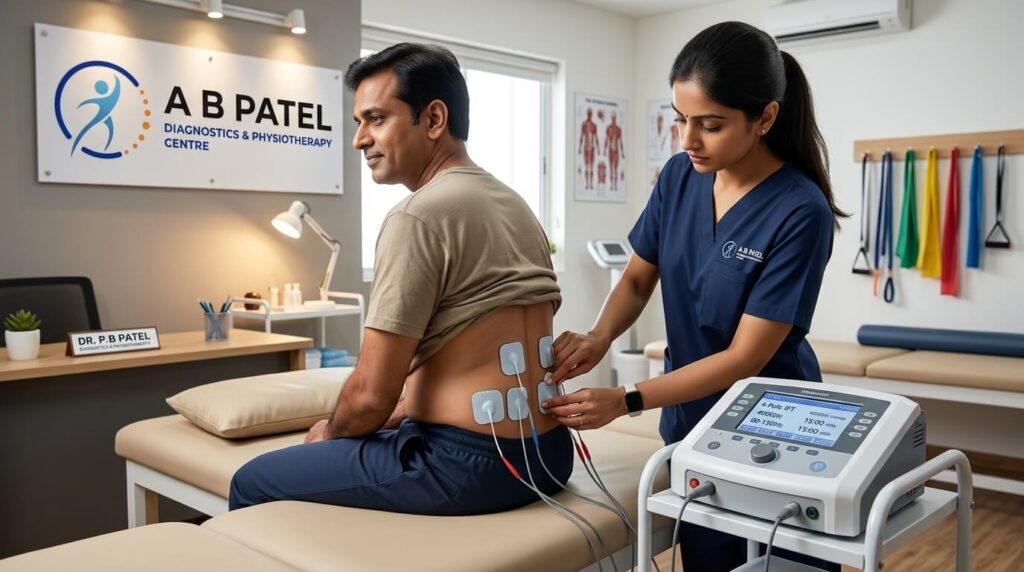
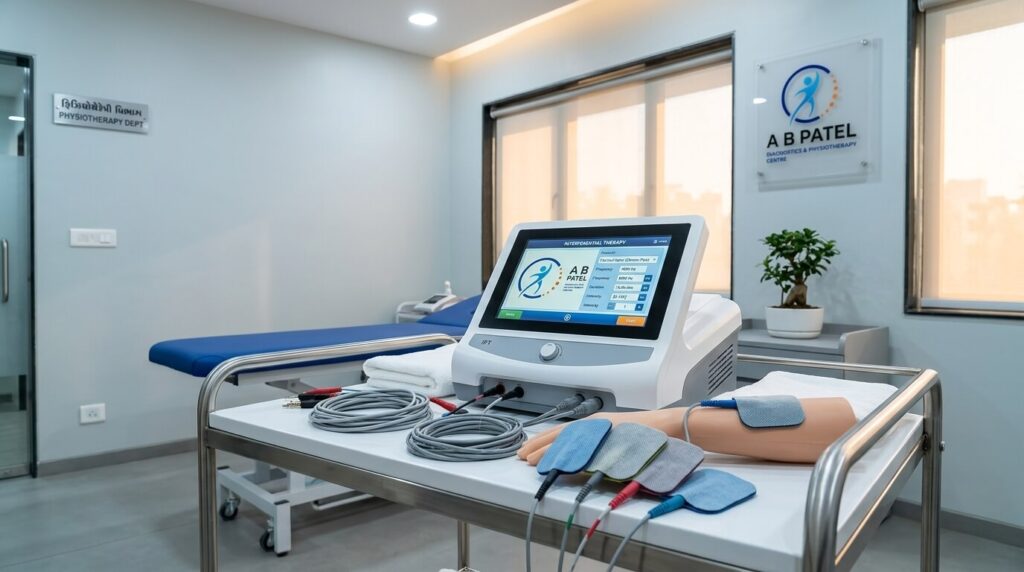
Understanding the treatment process helps alleviate any anxiety before your first visit. When you search for an Ift Physiotherapy near me, you want assurance that the protocol is systematic and evidence-based. The process begins with a detailed clinical assessment where our senior physiotherapists evaluate your pain scale, range of motion, and medical history. Next, four suction cups or adhesive electrode pads are placed strategically around the pain site. Sessions usually last between 15 to 30 minutes.
Consider a recent mini client success story: Mr. Mehta, a 45-year-old IT professional with severe lower back pain, struggled to sit at his desk for more than an hour. After a comprehensive assessment at our clinic, he underwent a two-week IFT protocol combined with core strengthening exercises. By his sixth session, his pain scale dropped from an 8/10 to a 2/10, allowing him to return to work comfortably. To learn more about identifying the right practitioner for your needs, you can read our guide on choosing the best physiotherapy approach.
Detailed Patient Case Study: Overcoming Chronic Sciatica
To illustrate the effectiveness of our clinical approach, let us review a detailed case study of Mrs. R. Shah, a 62-year-old retired teacher from Ahmedabad.
Patient Background:
Mrs. Shah presented with chronic, radiating pain in her right leg, diagnosed as sciatica. She had previously tried over-the-counter painkillers and basic stretching regimens with no significant improvement. The pain severely restricted her ability to walk, interfering with her daily morning visits to the local temple.
Diagnostic Evaluation:
Upon visiting A B Patel Diagnostics, her initial evaluation included an assessment of her nerve impingement severity. While she brought recent imaging reports from a previous hospital visit, our team conducted a thorough functional assessment to pinpoint the exact localized pain triggers in her lumbar region.
Treatment Protocol:
Our team designed a tailored 4-week rehabilitation plan. The primary intervention utilized digital IFT targeted at the L4-L5 lumbar segments to reduce the acute nerve inflammation and muscle spasms in her lower back. The frequency was carefully modulated to prioritize pain gating (blocking pain signals to the brain) during the first week, and later adjusted to promote deep tissue healing and increased blood flow.
Results and Outcome:
By the end of week two (6 sessions), Mrs. Shah reported a 50% reduction in radiating leg pain. By week four, the muscle spasms had completely resolved. We then transitioned her into an active strengthening program. Today, she maintains her mobility with occasional follow-up exercises and enjoys her daily walks without reliance on oral painkillers.
Frequently Asked Questions
1. What exactly is IFT physiotherapy and how does it work?
Interferential Therapy (IFT) uses medium-frequency electrical currents that cross each other to penetrate deep into soft tissues. This interference stimulates local nerves to block pain signals, reduces swelling.
2. How long does a typical IFT session take?
A standard IFT session lasts between 15 to 30 minutes, depending on the severity of the condition and the specific area being treated. It is usually part of a broader 45-minute physiotherapy appointment that may include manual therapy and exercises.
3. Is IFT safe for individuals with high blood pressure or diabetes?
Yes, IFT is generally safe for patients with hypertension or diabetes. However, thorough screening is required. A B Patel Diagnostics ensures complete medical histories are reviewed prior to treatment to ensure absolute safety.
4. Can IFT cure my chronic back pain entirely?
While IFT is highly effective at reducing acute pain, inflammation, and muscle spasms, long-term resolution of chronic back pain usually requires a combination of IFT, postural correction.
5. How many sessions will I need before I see improvement?
Many patients experience mild relief after the very first session. However, for sustained results, a typical protocol ranges from 6 to 12 sessions over a few weeks.
6. Does IFT have any side effects?
IFT is a non-invasive, safe modality with minimal side effects. Very rarely, patients might experience slight skin irritation from the suction cups or electrode pads, which resolves quickly after the session.
7. Do I need a doctor’s referral to start IFT treatment at your center in Paldi?
While a referral from an orthopedic doctor is welcome, it is not mandatory. Our experienced physiotherapists conduct a thorough initial assessment to determine if IFT is the right modality for your specific condition.
